Turing Conjugation
There’s this concept of “Russell conjugation”. You can have two phrases that in a technical sense, mean the same thing. But you imply a different emotion with each one. What’s the difference between being stubborn, and being persistent?
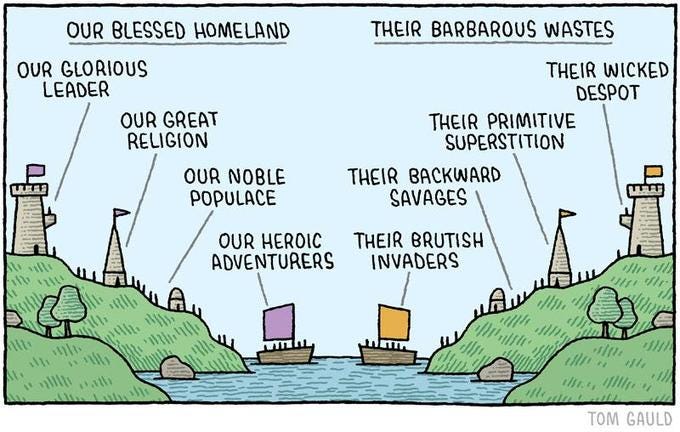
Of course, there are many words that mean approximately the same thing, just with a different connotation. (Did Bertrand Russell invent Russell conjugation, or did he discover it?) This is a “conjugation” because there’s a specific, parallel transformation you can do with the different words. You take the positive emotion and turn it into the negative emotion. “Confident”, swapping good for bad, becomes “arrogant”.
I guess I should back up and talk about “conjugation” itself. In the most common meaning of the word, conjugation is about verbs. Like singular or plural. I jump, he jumps. I think, he thinks. For mathematicians, though, there are also a lot of concepts in math which are called “conjugates”. The one you’ve most likely heard of is with complex numbers.
2 - i
2 + i
If you swap i with -i, you get the “complex conjugate”. This one is particularly interesting because the complex conjugate behaves in exactly the same way as the original number. There’s no difference between i and -i. If you redo the whole world of mathematics but replace i with -i, it’s all the same. This is as opposed to, for example, 2 and -2, which you can tell are different because one satisfies x * x = x + x and the other doesn’t.
Like the right-hand rules in physics. If you consistently use the “left-hand rule”, ie the opposite of whatever the right-hand rule tells you, then your answer to all physics questions will still be correct, because left and right are symmetric in physics. (Reverse definitions where appropriate. And weirdly enough, this is only approximately true, until you get to the weak nuclear force interacting with fermions.)
This mathematical conjugation is really a lot more similar to Russell conjugation than grammatical conjugation, isn’t it? I feel like it’s no coincidence that Russell was a mathematician who studied the philosophical foundation of mathematics, where questions like the philosophical difference between i and -i come up.
The Original Turing Test
An unusual, often overlooked aspect of Turing’s classic paper where he invented the Turing test is that he first describes a slightly different game. There’s three people: a man, a woman, and an interrogator of either gender. The interrogator can only communicate through written messages, the man pretends to be a woman in the messages, and the point of the game is that the interrogator has to figure out which person is the real woman, just from their written communication.
Only after introducing the gender game does he go on to describe what we now call the “Turing test”. Instead of asking philosophically, “is the computer intelligent”, we should ask, “does it act in a way that is equivalent to being intelligent”.
Implicit in this framing, I think, is that Turing is saying, if it acts like it’s intelligent, then essentially, it is intelligent. And if people object philosophically, you can use this fallback mechanism. It’s like a debate trick to defeat opponents who want to declare themselves the victor by definition. You can say, yes, yes, technically according to your definition it isn’t intelligent. But in all externally observable ways it’s intelligent, so let’s just treat it like it’s intelligent.
(And you have to wonder, why did Turing include the original gender-based imitation game at all? It isn’t really necessary to clarify the concept. But if you accept his definition of AI, as so many people have, then by analogy, perhaps you should also accept the principle for the original game, that if someone behaves indistinguishably from a woman then they essentially are a woman. Maybe Turing really wanted to make that point, but the only way to communicate this concept in 1950 was to write the foundational paper for a big new intellectual field, and sneak this argument in on the side.)
Turing Conjugation
So extract just the philosophical trick that Turing is doing here. We have a debate which is fundamentally tied to a fuzzy definition. Are the computers intelligent? And we can clarify that debate by replacing the “is” with “acts indistinguishably from”. This turns a philosophical question into an engineering question.
Are the philosophical questions and the engineering questions the same? Well, not exactly, but I feel like in the long run, it’s going to win out. As you live your life, if two things seem identical, it’s human nature to treat them as identical. But even if you don’t agree, it’s worth conjugating these questions about whether an AI is intelligent, to whether it can do particular tasks, because it leads to more interesting questions.
Here’s an example. Recently a bunch of mathematicians wrote a “call to action about AI. The Leiden Declaration. There’s a lot in here but let me pick out one example:
Affirm the humanity of authorship
Credit and responsibility continue to belong to humans within the mathematical community and should not be given to automated systems. Artificial intelligence may obscure, but does not replace, the collective human labor behind a result.
Does credit belong to humans, or to the AI? This is a philosophical question in the sense that you can’t precisely define “deserving of credit”. So do a Turing conjugation on it. Are the AIs capable of acting indistinguishably from the ways that human mathematicians do, when the human mathematicians get credit?
Well, not right now. A human mathematician typically gets going on their own. They decide on what they want to work on, work on it for a while, and at the end they produce a paper, and convince a set of established human mathematicians that it’s good mathematics.
The AIs can’t do that. Not yet! But will they ever do that? This is really an engineering question, not a philosophical one.
What if the AIs could do that? What if, one day, OpenAI or some other lab says, okay, we’ve built this AI system. Every so often it invents some new math, and reaches out to human mathematicians to share its proof and convince them. No human involvement after the initial setup.
Would “credit and responsibility” continue to belong to humans in that scenario? That doesn’t really make sense, does it? What humans deserve the credit?
I think the authors of this declaration are quietly assuming that the technology will never reach that point. Or perhaps “hoping”.
Can AI make art?
Here’s another example. Ted Chiang, greatest science fiction short story author of the modern era, wrote in the New Yorker a couple years ago that AI cannot truly make art.
Whether you are creating a novel or a painting or a film, you are engaged in an act of communication between you and your audience. What you create doesn’t have to be utterly unlike every prior piece of art in human history to be valuable; the fact that you’re the one who is saying it, the fact that it derives from your unique life experience and arrives at a particular moment in the life of whoever is seeing your work, is what makes it new. We are all products of what has come before us, but it’s by living our lives in interaction with others that we bring meaning into the world. That is something that an auto-complete algorithm can never do, and don’t let anyone tell you otherwise.
It is completely and entirely true that right now, AI writing is not good in a literary sense. It does not reveal subtle ideas, it is not insightful, its characters are not gripping and human. It’s also frustrating to see people enjoy a written piece that I personally consider to be obvious AI slop. And it’s frustrating to ask someone a question and get an enormous AI-written response when I wanted a concise human one.
Nevertheless. Let’s Turing transform this. Can AI generate a short story that is indistinguishable, by intelligent, sophisticated humans, like Ted Chiang himself, from the output of the finest human authors?
If it could, then I think Ted would have to concede the philosophical point. He would want to read these hypothetical great stories! If there’s a short story that you love, then what’s the point of defining it as “not art”?
Will AI ever get there? I don’t know. I think it’ll be harder than mathematics. The training data is unclear. It’s hard to imagine a world where the AI completes The Pale King, I read it, and I’m just astounded by how great it is.
It’s a hard challenge. It might prove to be an impossible one. But it’s an engineering challenge, not a philosophical one.
In addition to that point about gender at the beginning, Turing makes an interesting oblique point about race. In discussing whether a machine could ever enjoy strawberries and cream, he notes that having shared interests is sometimes important for interesting conversation and friendships “like that between white man and white man and between black man and black man”. I’m not entirely sure what he’s suggesting here, but I suspect it’s pointing out the ways that humans haven’t always treated humans of other cultural groups well, because we don’t share enough background to properly appreciate each other’s perspectives.